

California Organized Retail Theft Laws & Defenses
Retail theft prosecutions in California have evolved far beyond basic shoplifting accusations. Under California Penal Code § 490.4 PC, state authorities specifically target coordinated networks, resale operations, and individuals accused of conspiring to steal store merchandise. With local law enforcement task forces ramping up investigations across Los Angeles, a single arrest can quickly escalate into a life-altering felony charge. If you or someone you care about is facing an organized retail theft investigation, the uncertainty and legal pressure can feel overwhelming. Understanding the strategy prosecutors use to build these cases—and how a skilled defense attorney can dismantle them—is critical to protecting your freedom. At The Law Offices of Arash Hashemi, we bring over 20 years of criminal defense experience to safeguard your rights and fight for your future. Call us today at (310) 448-1529 or schedule your free consultation online to get immediate legal support.
What Is Organized Retail Theft Under PC 490.4?
Unlike simple shoplifting or petty theft involving an individual acting alone, PC 490.4 focuses on structured, repeated, or multi-party theft operations. Under California law, organized retail theft occurs when a person engages in any of the following acts:
- Acting in Concert to Steal: Collaborating with one or more individuals to steal store or online merchandise with the intent to resell, exchange, or return it for value.
- Receiving Stolen Retail Goods: Working with two or more people to purchase, hold, or receive merchandise known or believed to be stolen through a retail theft scheme.
- Acting as an Agent or Runner: Stealing property from a merchant while operating as an agent for another individual or organized ring.
- Organizing or Financing: Recruiting, supervising, directing, or funding others to execute retail theft schemes.
How Prosecutors Prove an Organized Scheme
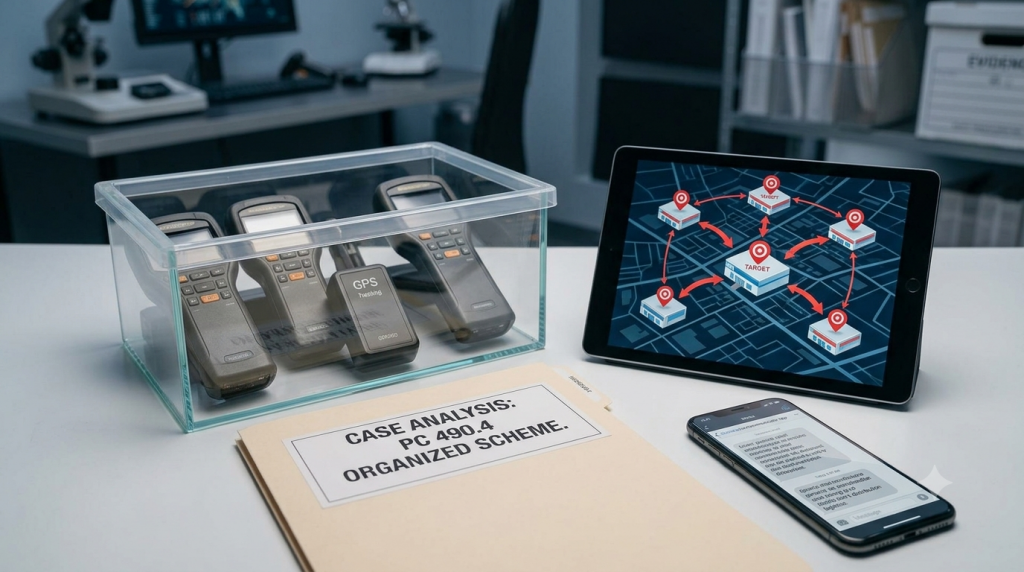
To secure a conviction under California Penal Code § 490.4 PC, District Attorneys cannot simply prove that store property was taken; they must convince the court that the act was part of a structured, preplanned operation rather than an isolated incident. Prosecutors build these cases by gathering physical, digital, and circumstantial evidence to convince a judge or jury that a coordinated effort took place.
- Digital Records and Prior Coordination: Investigators meticulously search cell phones, text messages, and social media channels to establish communication between co-conspirators. Showing pre-arranged agreements, shared planning, or previous instances where individuals worked together allows prosecutors to frame the event as an ongoing criminal enterprise.
- Possession of Specialized Theft Tools: Carrying tools specifically designed to bypass store loss-prevention systems is one of the strongest pieces of evidence used by law enforcement. Items such as foil-lined “booster” bags, magnetic tag removers, wire cutters, or counterfeit receipts demonstrate advance preparation and an intent to commit organized retail theft.
- Unusual Quantities and Commercial Intent: Prosecutors closely analyze the volume and nature of the seized merchandise to argue against personal use. Recovering multiple identical high-value items, high-end designer goods, or bulk quantities far exceeding what a single consumer would buy helps the state prove that the items were stolen for the explicit purpose of reselling or fencing them for profit.
Penalties: Is PC 490.4 a Misdemeanor or a Felony?
Because organized retail theft is classified as a wobbler in California, District Attorneys have the discretion to file PC 490.4 as either a misdemeanor or a felony based on the underlying circumstances and the accused’s prior record.
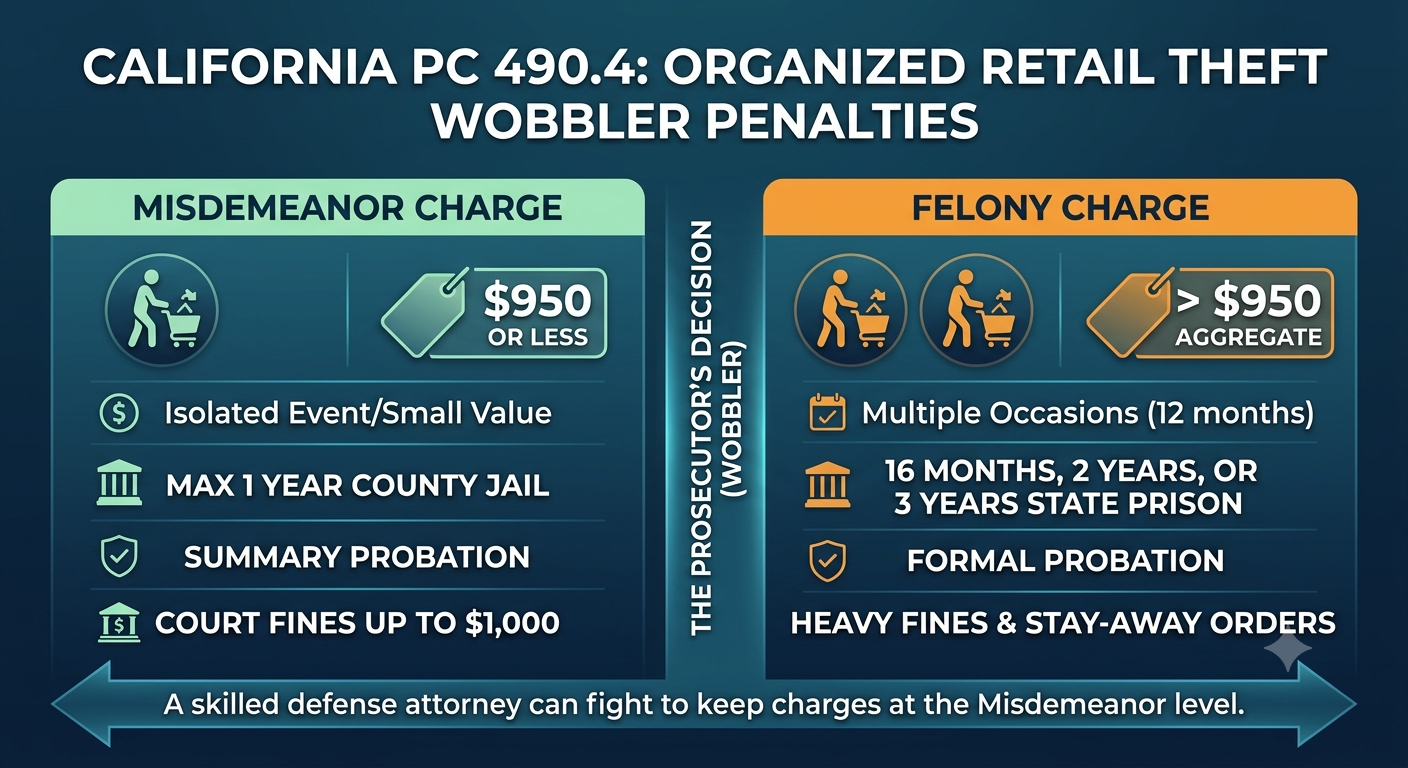
- Misdemeanor Violations: If the alleged retail theft involves an isolated incident or stolen property valued at $950 or less, the offense is charged as a misdemeanor. A conviction carries up to 1 year in county jail, summary probation, and court fines reaching $1,000, in addition to mandatory restitution for the value of the missing merchandise.
- Felony Violations: Prosecutors can elevate the charge to a felony if the total aggregated value of the stolen, received, or resold goods exceeds $950 across two or more separate occasions within a 12-month period. A felony conviction exposes a defendant to formal probation or formal custody terms of 16 months, 2 years, or 3 years served in county jail or state prison.
Beyond jail time and fines, courts routinely issue formal stay-away orders as a mandatory condition of probation. These restraining orders legally prohibit you from returning to or coming within a specified distance of the targeted retail stores for up to two years.
Defense Strategies Against PC 490.4 Charges
An arrest under PC 490.4 does not guarantee a conviction. Because prosecutors face a high legal burden to prove a coordinated ring existed, an experienced defense attorney can challenge the state’s case using several key strategies:
- Unlawful Police Search: If law enforcement searched your vehicle, phone, or belongings without probable cause or a valid warrant, your attorney can file a motion to suppress that evidence, which often leads to a complete case dismissal.
- Proving You Acted Alone: PC 490.4 strictly requires evidence that you acted “in concert” with others or as part of a theft ring. Demonstrating that there was no agreement, communication, or partner involved invalidates the organized charge.
- No Proof of Intent to Resell: The state must prove you intended to sell or trade the stolen goods for financial gain. Without evidence of a resale plan, charges can often be negotiated down to basic petty theft or simple shoplifting.
- Mistaken Identity: Retail theft investigations rely heavily on grainy surveillance footage and hasty loss-prevention reports, making it easy for innocent bystanders or shoppers to be misidentified as co-conspirators.
Speak With a Los Angeles Criminal Defense Attorney
If you or a loved one is facing organized retail theft charges, acting quickly to secure experienced legal representation is essential to protecting your freedom and future. At The Law Offices of Arash Hashemi, we bring over two decades of criminal defense experience to examine whether police violated your Fourth Amendment rights during a stop, challenge claims of an “organized scheme,” and push to get felony charges reduced or dismissed entirely. Los Angeles defense attorney Arash Hashemi focuses on exposing weaknesses in the prosecution’s evidence and building a targeted strategy to secure the best possible outcome for your case. Don’t try to navigate California’s legal system alone when your record is on the line. Contact us at (310) 448-1529 to discuss your case with a Los Angeles criminal defense lawyer, or Schedule a Free Consultation Online at a time that is convenient for you.
The Law Offices of Arash Hashemi
11845 W Olympic Blvd #520
Los Angeles, CA 90064
📍 Get Directions
Disclaimer: The content provided here is for informational purposes only and does not constitute legal advice. It is not intended to predict outcomes, as individual circumstances vary and laws may change over time. Those seeking legal advice should consult with a qualified attorney to understand how current laws apply to their specific situation. For detailed legal guidance on the topics discussed, please contact our law firm directly.
